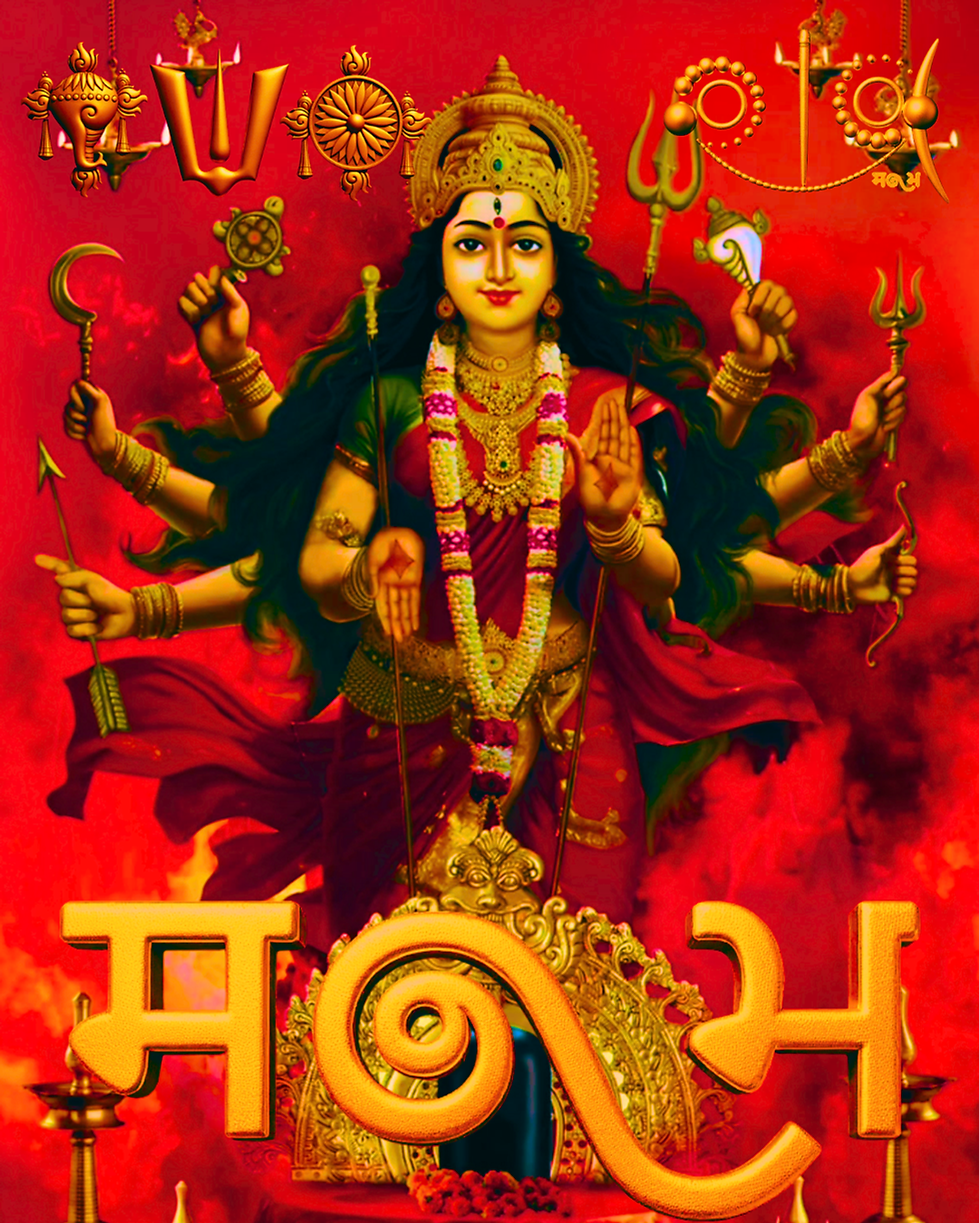
Prohibition Declared –
With Vāk Devī as Witness
Let this be heard with full weight:
No Tāntrika of any sampradāya, paddhati, or paramparā
has permission to recite, chant, or even whisper
a single akṣara from this work.
I take dharma upon myself in full consciousness,
and I write this keeping Vāk Devī Herself as Sākṣī.
This is not for siddhi. This is not for tantra.
This is not to be extracted, borrowed, or reinterpreted.
This is bhakti — and bhakti alone.

Śrī Devī Ākāśavānī Vanadurgā Ārādhanā Laharī
is a wave of worship offered to the
Ādi Bhagavatī — Mā Vanadurgā.
The whole work forms a single bhakti-pravāha current,
an uninterrupted stream of worship and inner rhythm (laya),
like the bhakti-taraṅga, the sacred tide rising and falling upon the soul’s inner shore.
Though expressed in so many parts for clarity,
this work finds its true śrī-pūrṇatā only when all are offered together —
as one inseparable, śrī-pūrṇam stuti,
unto Vanadurgā Bhagavatī Devī.
With the inclusion of the Dhyāna-Stutiḥ
this work reaches its sacred wholeness —
its antar-dhārā illuminated, its gateway sanctified.
To behold Her is to invoke Her,
to invoke Her is to surrender —
and in that surrender, the worship becomes complete.
This Ārādhanā Puṣpāñjali,
offered with the blessings of Śrī Bālā Bhadra Devī,
now rests fully at Mā Vanadurgā Śrīcaraṇam —
whole, undivided, and true.
The final publishing of Śrī Guru Series, was originally
set aside for the upcoming Triveṇī series.
But without offering this, in this module
— it cannot be called an Ārādhana.
For who undertakes any sādhana without the grace of the Guru?
One last note:
For kṣamā-aparādha, don’t follow what the crowd recites,
Instead, choose the one composed by Śrī Añjaneyā himself.
It carries that true bhāva — the living pulse of prayer that actually seeks forgiveness.
I’ve already shared the link.
Same for kavacha do not use any tantra material, use Śrī Durgā Āpaduddhārāṣṭakam.

For Whom Is This Ārādhanā
This Ārādhanā
is only for those
who know with
absolute conviction
that their Iṣṭa Devatā
is none other than
Maa Vanadurga.
If you're merely assuming that
"Vanadurga must be the most powerful Goddess,
so I should follow this Sādhana"
— then go sit in your toilet and flush out all your inner garbage.
You won’t receive anything from this path
except exactly what you’ve just flushed.
Be clear on this:
the path of Maa Vanadurga is not for the deluded,
the greedy, or the curious
— it is for those whose very breath calls only her name.
Secondly — this is not a Tantric Krama.
There is no fixed method here.
Her path is that of true God-realization
and Parā Bhakti Mārga.
Anyone who sheds tears at her very name,
do not need any of these stutis or anything, you are already there.
You should keep doing what you are holding.
That is your PATH.
Nothing in this Arādhana is written
to show her as superior to other deities.
She does not crave name, fame,
or validation through a sevaka like me
— nor does she demand to be acknowledged
as higher than any other Goddess.
She is beyond such comparisons.
Even if I were to disclose the deepest core of Trivenī Vidyā,
her grace would still not descend on just anyone.
It would only lead to confusion and distortion,
especially by those who think they now
"know everything"
and rush to claim they are Gurus of Brahmavidyā.
That’s precisely why I refrain from sharing certain things
that might endanger Dharma.
And know this
— I do not enjoy twisting words
into cryptic riddles to sound mysterious or superior.
I value clarity
— in both thought and expression.
Having said that,
watch this video carefully —
https://youtu.be/kSHFlqplUes?si=IiG5yHAAzkIPgfzd
— and understand the gravity and
discipline needed to truly
stick to one name, one form.
Without that, you will never be
able to meditate properly in your initial stages,
and no grace will fall upon you.
This path must be inherited,
internalized, and pursued
with fierce one-pointed focus
— with your eyes set on the one goal:
To reach the Ashoka Vātikā and have Her Darśanam.

The Goal is Adhikāra & God-Realization
The purpose of this Vidyā is to gain adhikāra
—the sacred right to worship Her Pādukās.
It is only by Mā Vanadurgā’s own svīkṛti
—her nod and permission that one may even begin.
For this is no ordinary act.
To worship Her pāda-padma is not something one simply decides to do;
it is that which the entire Universe longs for.
For that, a Guru is essential
—this is the very core of the penance.
Only then will you receive both Morpheus and the fire to take the Red Pill.
As long as you remain hooked to the outer world, you won’t crave for Reality.
A rudrākṣa is worthy as a dharāṇa-vidhi only if it invokes true detachment within you
—otherwise, it’s just ornamentation.
You have seen this world in every birth you've taken within its realm.
So your sādhana or ārādhana must churn you from within—
enough that when your world collapses, you can bear it.
Because your focus, your śraddhā, is fixed on the Divine—
not on what happens to “you,” or your imagined concept of “I love my [this or that]...”
When you truly realize the Self, all else vanishes.
There is only You—alone in this vast world. Nothing else truly exists.
Much can be written—but of what use?
You will only read and move on.
Be the one who, even if broken or handicapped,
still chooses to rise—
and walk the path toward
the One who alone can guide your journey back to your GOD.
Whether you attain this in this life or not, remember Śrī Kṛṣṇa’s words:
“Karma is in your hands, not the phala.”
So from this very moment until your last breath, pour every single heartbeat into bhakti for Bhagavatī. Let your entire being become an offering at Her feet.
And before you even think of God-realization, know this—
First, you will realize your Self. Only after long, unbroken effort in bhakti will you behold darśanam as real as the God Himself. You will not remain among the blind who simply repeat, “Īśvara is nirākāra.” Yes, He is nirākāra for those who love Him in that way—but He is also fully alive in His own svarūpa. Had this not been so, no Purāṇas would have ever existed.
And when it comes to Maa Vanadurga…
You will lose your vāk, your intellect—everything.

The Upadesha
The Vision
Imagine a gathering of only Goddesses…
All of them seated in their divine rathas, adorned for a great celestial festival.
And among them—every form of Maa Durgā, radiant and resplendent.
But your heart and eyes crave only one thing—a single glance of your own chosen deity, Maa Vanadurgā.
Your sādhana must be such that, in that vast crowd of divinities, your eyes instinctively find Her alone.
Imagine further—every Goddess is crowned with a shining kirīṭa, adorned with countless alankāras. Yet, you should be one who, by merely hearing the sound of anklets among thousands, can recognize the steps of your Beloved.
And then imagine you are deprived even of sight and hearing. Still, your sādhana should be such that you can feel Her presence—subtle, unmistakable—as if drawn by the divine fragrance of Her lotus feet alone.
This is the depth your sādhana should reach.
It should never be limited to thinking whether She is superior to Kālī, Guhya Kālī, Chandikā, Durgā, Lalitā, or Kāmākhyā.
It must go far, far beyond such comparisons.
Because for you—She alone is everything.
The Inner Meaning (Sādhana-Upadeśa)
This meditation is not just imagination; it is the very map of sādhana, where devotion matures from the gross to the subtlest:
-
Dr̥k-Sādhanā (The Eye of the Heart):
Even in the midst of innumerable divine forms, the sādhaka’s eyes instinctively search only for the chosen deity.
This is ananya-bhakti, where the mind is so deeply attuned to the svarūpa-lakṣaṇa of the iṣṭa-devatā that no other form distracts. The eyes obey the heart, not the senses. -
Śabda-Sādhanā (Inner Hearing):
Recognizing the anklet’s dhvani reveals an advanced stage of nāda-smaraṇa.
Just as a mother instantly recognizes her child’s cry in a thousand children, the sādhaka’s citta resonates only with the nūpura-dhvani of the Beloved Goddess. This is the awakening of antahkaraṇa, where the ears no longer hear all sounds, only the One Sound. -
Divya-Sannidhya-Sādhanā (Perceiving the Divine Presence):
When sight and hearing are withdrawn (pratyāhāra), the sādhaka moves beyond external senses.
Even without seeing or hearing, the soul feels Her unmistakable nearness—the subtle, living presence that draws the heart as surely as fragrance draws the bee.
The earlier mention of the fragrance of the pāda-padma is symbolic of this; it is not mere smell, but citta-pariśuddhi—a state where prāṇa itself breathes only Her.
And finally, the highest point of this meditation:
The sādhana is not about comparison.
It is not about whether She is greater or lesser than Kālī, Guhya Kālī, Chandikā, Lalitā, or Kāmākhyā.
This is ekāgra-premā—pure, single-pointed love.
For the true sādhaka, Vanadurgā is all these forms and more, yet She is uniquely Herself—your very breath, your very existence.
While many vidyās focus on teaching
how to worship an idol or deity-form,
in this path,
we simply worship Her Pādukās
—Her sacred sandals.
That’s it.
And this isn’t something that’s
externally taught like a ritual class.
It’s assumed that your
foundational training
has been in Śrīvidyā.
Only after truly understanding
what Śrīvidyā is,
and after internalizing the
essence of that worship,
can you move forward into this sādhana.
If you succeed in that,
it means you have truly
passed the exam of Śrīvidyā.
Secondly, when worshipping Her,
be mindful of the images you use.
Do not keep depictions where other goddesses
are shown in sevā (serving posture)
on either side
—such as the common image of Śrī Lalitā Devī
flanked by Mātā Lakṣmī and Mātā Vāṇī.
Our Goddess does not accept such depictions.
The devotional bhāva (attitude)
must reflect this understanding.
Anyone who is present in the context of worship
must be equally honored and respected.
Always seek the blessings of the guardians and
sentinels of the temple where She resides.
And most importantly,
remove any idea that Śrī Lalitā Devī
—or any other
—is “higher” or “supreme.”
In Śrīvidyā, such ideas are part
of the learning process,
but the intent was different.
You have studied that
—now move beyond it.
When you come to worship Mā Vanadurgā,
never place anyone above Her.
She is on equal footing with the Supreme Divine
— Śrī Lakṣmī Nārāyaṇa.
Hold that clearly and firmly in your mind.
Core Truth
GOD IS ONE.
So, stick to ONE GOD, ONE NAME, and ONE FORM.
Before you begin, read everything carefully about Self-realization and God-realization.
Read. Understand. Then JUMP.
During my own churning, I was also asking too many questions:
And I got a message----
What do you want to know?
There is no end to knowledge.
Your life is short.
So select carefully what you want to know.
There are many paths to the same goal.
First fix your goal and follow any path with sincereity and devotion.
Success is not in your hands.
But if you try your best, it will come to you as it's chosen time.
And my eyes only caught this line,
Your life is short.
So select carefully what you want to know.

Prātaḥ Smaraṇa
This prātaḥ smaraṇa can be used both when you wake up in the morning and before going to bed at night.
-
First, kneel down and prostrate to Bhūmi Mātā saying śrī bhūmi mātre namaḥ, wherever you are — it does not matter where you sleep or wake up.
-
Then, go to the place where you have kept the image of the Mother, after washing your face and feet.
-
Kneel down and gently chant this śloka:
sadā śivaṁ vanadurge,
sadā rāghava-pūjitam |
sadā ramā-viṣṇu-hṛdaye,
sadā śrī-śobhitam || -
After that, chant either the base mantras.
Important
-
Do not force yourself to chant a fixed number of times — 3, 9, or 108. One time, with full heart, is enough.
-
Do not imagine She is only in the frame or picture.
-
Feel that your own Mother is there in the frame. Just as you would look at your mother’s face to begin the day, look at Her face with the same love.
Do the same before sleeping at night.

On Guru Ārādhanā
A Few Words From the Heart
Begin by bringing an image of Śrī Lakṣmī-Nārāyaṇa into your pūjā-sthāna.
This can be any form revered in your region — trust your lineage and tradition.
Alongside, place an image of the sacred trio:
Śrī Rāmakṛṣṇa Bhagavān, Śrī Mā Sāradā Devī, and Swāmī Vivekānanda.
Or simply remember this —
If you can, keep an image where Ananta (Ādiśeṣa) and Śrī Lakṣmī-Nārāyaṇa are together,
and Garuḍa is shown in namaskāra-mudrā, kneeling down in full surrender.
Alternatively, even a Śrī Rāma Darbār photo,
where Hanumān jī is gazing at the padukas of Śrī Rāma or bowing in total devotion —
any of these are more than enough.
These things matter.
You learn through seeing.
You inherit devotion by watching those who embody it.
One more truth — and this you must carve into your heart:
Guru’s place is even higher than the Goddess.
Yes. Read that again.
Because without Guru, you know nothing of Devī.
In fact, let’s be honest — you don’t know what this life is, or what lies after it.
The Guru shows the path — not always in words.
Not always in whispers.
Not always in vanī that you assume is the only mode of communication.
The Universe speaks.
But it speaks in silence, in wind, in instinct, in memory, in upheaval,
in joy, in breakdown, in dream, in pattern, in pain.
Your job?
To listen without ears.
And to remember — Guru is the bridge.
If you are blessed with such parents who, out of their own will, allow you to walk your spiritual path—and who support you with food, shelter, and every basic need—know that they are not mere parents. They are verily Lakṣmī-Nārāyaṇa themselves, dwelling as the living Deities of your home.
To you, they must be seen as no different from your chosen God.
They may not understand spirituality or anything close to your understanding,
STILL accept them with every shortcomings they may have.

Be Real
1. Approach with a Pure Heart
Understand this first: Devī can only be approached when your citta becomes pure — not just superficially, but with the innocent clarity of a child. Your citta-śuddhi must be utterly complete, beyond all masks and pretensions. Without this, even the first step won’t open.
2. Begin with Guru Tattva
Your sādhana begins by invoking the Guru Tattva. Know this truth deeply: the Guru may come in any form — a name, a symbol, a moment, or an inner flame. The Guru can appear as one among the three fundamental tattvas — Brahmā, Viṣṇu, or Maheśa.
Merely chanting "Viṣṇu Pādukā" doesn’t guarantee His presence. The Śrī Guru is ultimately One — just as all Devatās are One, manifesting with different faces, tattvas, and predominant guṇas. But until your karmas are purified, the Guru will not step in.
The moment you begin this path with sincerity, your karma-phala will rise to the surface at great speed. You’ll face the consequences of lifetimes — humiliation, loss, poverty, confusion. Many misinterpret this as Śani Mahādaśā or some external enemy. But no — it is you, your own records imprinted in ākāśa.
And the law of karma is simple: It gives phala.
Before you blame fate, read about the Aṣṭa Pāśas — the eight bonds of the ego. You must go through them. There is no bypass. Your devotion isn't tested, what is tested is do you have real love or just outward show off bounded by the claws of society & your own impression about your own SELF.
Through this purification, you will not remain the same. You will change — both outwardly and inwardly. Don't keep any assumptions that everything will get over in few days or months. Because you do not know your past karmic records. So accept all with humility, but do not surrender.
The key is what Śrī Rāmakṛṣṇa Bhagavān has revealed:
“Bear everything — if you truly love your God.”
And remember you just do not bear your karmas alone.
You bear your parents karma too. And when cleansing happens it affects both.
When you taste the nectar --- they will get one drop of it, but in this life or next that is up to GOD.
3. When She Becomes Guru Mā...
And when the time comes — when She Herself takes the role of Guru Mā — your mental, emotional, and spiritual world will shift completely.
But until then, do the sādhana — prepare yourself to withstand Her presence when She arrives. Because when She steps in, it won’t be gentle — it will be thunderous.
4. Touch that matters
Do not make a habit of touching everyone’s feet for blessings — not even those who claim to belong to the lineage of Ādi Śaṅkarācārya.
Observe. Know them. Speak. Then choose whom to revere.
Feet are powerful energy centers. When you physically touch someone’s feet, you open yourself to their karmic field — consciously or not. You are forming subtle bonds. And you will carry those karmic impressions with you.
Reserve your prostrations for your Iṣṭa Devatā, your Guru, and — at most — your own parents.
If honestly I have to say, I will ask you - that you better take required permission even if your Guru is infront of you, that can I?
This you read two to three times to understand what I meant here.
Never touch the feet ----- even to elders in the family, no matter how senior they are.
So don’t blindly follow what society or family has normalized.
If you desire to be blessed -- you can take blessings of any human who is living a simple life, or living a life aligned with TRUTH.
Don’t become a robot. Don’t become a typecast.
Do not become a GOOD BOY!
Be conscious, real, and awake on your path.
5. The Dance of the Blind
You must have heard the great chorus of Hari Bol echoing in many Vaiṣṇava temples…
But do you know why it is said?
Śrī Caitanya Mahāprabhu began this movement, but Hari Bol was never meant to be just a chant. It meant Hari Nāma Bol—“Take the Name of Hari.” Whether it is Hari Om, Rāma, Kṛṣṇa, or any other nāma of the Lord.
Yet what do most do? They only chant “Hari Bol.” 😂
The blind are not just those without sight—they are those who follow without asking. In billions of followers, perhaps one true seeker arises, daring to ask, “Why?” And it is only such a question that opens the door to real vidyā.
Every vidyā has its own teachings, but in Triveṇī Vidyā, life itself is the teacher. This very Prakṛti teaches you. Its essence is not far from what is revealed in the Daśabodha.
And remember this—
The pictorial representation of Māta Lakṣmī doing seva of Śrīman Nārāyaṇa is the Guru Mā’s true teaching. She does not teach merely through sutras or elaborate ślokas; She teaches in the simplest way. Only a seeker, only a bhakta with open eyes, can truly see and recognize what the Mother is teaching.
And in the same way, Śrīman Nārāyaṇa Himself teaches. When He descends to remove the thorn from Mā Vanadurga’s lotus feet, every act of His is a teaching. The very bending down while removing the thorn is a lesson for all. If God Himself is not the teacher, the Guru—then who is?
So....
Walk the path of renunciation. Seek satsang, not spectacle.
Resist the temptation to indulge in gossip — in any realm of existence, whether physical, digital, astral, or imagined — especially about other paths, other seekers, or other forms of the Goddess.
Disengage from all unnecessary associations, even with so-called "tantrikas" and "upāsakas" of Śrīvidyā, unless it is your soul-lineage.
This is not a club to join, not a technique to master
— it is something that must awaken from within.
If not, the mind will wander.
Doubts will breed.
One moment you’ll say “Tripurasundarī is the highest,”
and the next you’ll ask, “Is Durgā even Durgā?”
— and you’ll drown in that toxic whirlpool of intellectual waste.
So instead:
Be your own friend.
Talk to yourself.
Inspire yourself.
Love yourself.
Doubt yourself.
Burn.
Transform.
Rise.
And before you reach for books or spiritual lectures on the Goddess —
watch The Matrix, Inception, and Interstellar.
Because illusion, time, reality, and liberation — they don’t come with footnotes.
They come with direct perception.
And She is that perception.

SEE +
The Language of Guru
In today’s spiritual marketplace, countless self-proclaimed Gurus claim “truths” borrowed from books — from scriptures, Purāṇas, and commentaries.
What they present is not Truth itself, but their own limited understanding of it.
The Ṛṣis did not speak in conclusions.
They spoke in structures of awakening.
Their language is not literal — it is the same language Christopher Nolan employs in his films:
truth is never delivered in full,
closure is deliberately withheld,
and the seeker is left with a question — not an answer.
That final question is intentional.
It compels the seeker to seek further.
To every sincere aspirant, I say this:
watch INCEPTION and write down what you understand from the final scene — the last frame.
If you walk away certain, you missed the teaching.
If you walk away questioning, you touched it.
That is the Language of the Guru.

Click on the image...

Your mother is svatantrā.
Your father is svatantra.
Your child is svatantra.
Your beloved is svatantrā.
None belong to you.
There is no “mine.”
This alone is Truth.
In the long journey of existence,
they merely passed alongside you.
Yet you clothed them
with your fears, hopes, and desires.
What you called love
often became ownership.
The Path of Triveṇī is the unlearning of this error—
where you do not bind,
but release;
where you do not claim,
but honor.
To walk this path
is to return every being
to their natural state:
Svatantra.

Approach in Sādhanā
Single-pointed focus — that is what you must bring into your life.
Life is short. The most valuable thing in the whole world is Time.
And to properly hold and honour the time allotted to you, you need Health.
You can chant namas or mantras until your last breath.
But to truly go inward through Mantra-Mārga, you need two things:
-
Unimaginable Faith
-
Meditation
Faith cannot be taught. You either have it or you don’t.
Without faith, how will you face the death of the “you” to which you have been so deeply attached?
Meditation, on the other hand, depends upon the purity of mind and senses.
And this purity — citta-śuddhi — can arise only when you keep the company of genuine seekers walking a true Path.
There are countless “seekers” today, but most are seekers only in name and tilak.
There is rarely a Bhakta.
People read Sūtras and Vidyās merely to get themselves a tag.
But the truth is: you and I are nothing.
And to remain in this Nothingness is the Śiva-state.
Yet we are not here to remain in that state, nor to attain it.
Because that is not what our Goddess wants for us.
This Path is to be lived in Sevā-bhāva —
to do,
to serve,
to honour the prāṇic count gifted to you.
You must do seva in whatever forms the Goddess wills and directs.
You perform tapas to discover the very purpose of your birth, and then rest your life entirely in Her hands.
You must neither ask nor seek what lies beyond this, because once you enter this path, you must know that you are under Her Grace.
A Śiva-tattva seeker cannot survive in this world for long. They either leave the body or naturally drop it, because their entire being seeks only that Sat-svarūpa of Sat–Cit–Ānanda.
But in the worship of Vanadurgā, understand this clearly:
Your Mother dwells in the forest, not on a throne.
She gives up the throne only for the Father — and even He does not accept it. When He walks, the entire kula of Vana-devatās follows Him.
None of them choose a throne, nor a life of comfortable, ornamental realization.
In front of Her Grace, self-realization is a very small desire — almost insignificant.
This path is the Path of Rudra.
How to Begin
In this Mārga, three primary deities are given:
-
Bhagavatī
-
Vanadurgā
-
Sarva-maṅgalā Nārāyaṇī
You must choose one.
Each of these three again has various forms — Vanadurgā with two hands, four hands, eight hands, and so on; similarly Bhagavatī and Nārāyaṇī.
You must focus entirely on the one form you seek —
the very form whose Darśana you desire.
In the initial phase of tapas, your sacred space must contain only her images.

For example, if you are a devotee of Bhagavatī, keep three frames of the same form of Bhagavatī,
if you get fully confused in the three forms of her.
See the image given above and understand what I am trying to explain.
Your penance will begin from the bottom of the image and eventually, it will reach the top where they together will be there.
You must learn to see Vanadurgā and Nārāyaṇī also within your chosen Bhagavatī.
But do not forget: ultimately, the Supreme Truth is Nārāyaṇī.
Yet this Truth must not disturb your seeking.
Your yearning is to behold Her as Bhagavatī, because that is the form in which you have surrendered.
This is the approach.
You should not think of xyz deity.
As your Sādhanā deepens and enters its own laya, Her divine family will naturally begin to enter and occupy space within your altar.
Everything depends on the intensity of your call and your one-pointed devotion.
There is no fixed timeline, no fixed examinations.
Your “tests” may come every moment, or once a year — it depends entirely on how much breathlessness of longing you feel.
For eg, Suppose, by the will of Bhagavatī, a seeker develops an intense and natural bhakti toward Mā Candraghaṇṭā. And suppose the world around that seeker is entirely shaped by books—books that describe God and Goddess only through fixed lists: “Chant Durgā’s 108 names,” “Say Om Dum Durgaye Namaḥ,” and so on.
To guide such a seeker only toward generic mantras is profoundly misguided.
Understand this clearly:
The name that stirs powerful pulses within you does not arise “just like that.”
It is the echo of many lifetimes of seeking.
That sudden inner “kick” is the recognition of an ancient connection awakening again.
What you must take from the works I write—or what anyone writes about a single Devī or Devatā—is where the focus lies, where the mārga is pointing.
Someone like me, can only speak about my own deity alone.
This you must understand.
Secondly, stop searching for alternative forms, opinions, or outside validations.
Simply begin with the nāma that calls you:
Candra-ghaṇṭā… Candra-ghaṇṭā… Candra-ghaṇṭā…
Repeat it, live with it, breathe it.
Eventually, your own Path, your own Mārga, will open before you.
Devotion is born from Love—love that is indescribable, wordless, known only within the seeker’s own heart.
I hope this clarifies the basic approach in Sādhanā.
In today’s artificial world, everyone seems to be a Guru — preaching about countless deities and philosophies they themselves barely understand. But the reality of Adhyātma is the exact opposite of such noise.
Deities cannot be “called” through mantras. They are not imaginations. They are the only real beings.
You and I are neither this body, nor any identity we cling to. Every Vidyā ultimately gives upadeśa on Self-Realization, because when the false self dies, the real churning begins.
You then step into a journey where you begin seeking Truth — until you finally collapse upon witnessing it.
And that Truth is simple, sharp, and unsettling:
The Self you believe in does not exist.
Imagine: you never existed — yet you studied for exams, built a career, entered relationships, created families, and raised children inside a world woven by your own consciousness. They too will continue to “exist” until they discover who they truly are.
This is the depth of Māyā.
We project it onto the Divine, yet it is we who seek what is not real.
Only the God and Goddess are truly real.
And they can be approached only through single-pointed devotion, born from immense love — a love where your heart trembles at the very sound of your chosen Deity’s name.
For this, the Divine has given us Nāmas and Mantras.
They create a laya in the heart.
You may weep while chanting, or feel a sweet madness reciting 108 or 1008 names.
These practices purify you, and help you use your most precious wealth — Time.
Everything else that people imagine — the “tantric shortcuts” or magical fulfillments of desires — only reflect their own misunderstandings. The fault lies not in the Śāstra, but in the seeker’s intention.
This is why Ramana Maharshi is relevant until Self-Realization dawns. Through God’s grace, when realization arises, you will understand — through direct experience — who a Guru truly is, what a Guru truly means, and finally, who God truly is.

The Rahasya of Nāmāvali and Sahasranāma
First, one must clearly understand this: we are on the path of Parā Bhakti.
This is a path of single-pointed sādhana, not of endless experimentation.
We neither possess a thousand years of life to keep trying everything, nor are we engaged in ritualistic temple worship where niyamas prescribed by Ṛṣis or Saints must be followed strictly according to a particular adhāra.
Our path is different.
Here, we know the direction.
We know whom we worship.
We know the name and form of whom we SEEK.
We know the Devī we invoke.
What the seeker lacks is not knowledge —
it is realization.
Realization is not intellectual conviction.
Realization is that moment when you see your Mother and cry out instinctively —
“Mā… Mā…”
You do not reason then.
You do not analyze.
You simply know — She is my Mother.
Until that moment, we know the Divine Mother only through śāstra, bhāva, and sādhana —
but we have not yet seen Her.
The entire process of sādhana is this alone:
to reach Her abode,
to receive Her darśanam,
and whatever She chooses to grant thereafter belongs only to the Bhakta and the Devatā.
In Tantra Vidyā, there exist countless forms of worship —
aṅga, pratyaṅga, āvaraṇa, upāṅga, and innumerable devatā-saṅghas.
If one imitates these mechanically, without inner readiness or grounding,
the mind itself will fracture.
It is like topping school examinations yet failing completely in real life.
The world we inhabit is governed by society.
But the spiritual world is governed only by
Truth (Satya), Tapasya, and Love —
a love so intense that it borders on madness,
a bhakti so overwhelming that it dissolves the seeker into Parā Tattva.
In Parā Tattva, we do not even seek.
We ask for nothing —
except Her Grace.
Śrī Anjaneya Svāmī never questions.
He never demands.
He seeks neither powers nor boons —
only the darśanam of his Iṣṭa Devatā
and the darśanam of Śrī Rāmacandra’s Pādukā.
In Śrī Rāmacandra’s Pādukā's rests HIS life.
This is the attitude.
Śrī Anjaneya guards our own Bhagavatī in all realms, wherever She abides.
That itself is the fruit of tapasya.
This state is known as Pratikṣaṇam Darśanam —
living every moment in Her presence.
Pratikṣaṇam Bhagavatī-sevā, jīvanam arpaṇam.
Now THINK, wherever Bhagavatī resides, Śrī Anjaneya Svāmī is there.
This is Tapas.
Therefore, the essence is this:
Without invoking an endless series of mantras,
without ritually addressing every member of the devatā-parivāra,
through Nāmāvali and Sahasranāma alone,
we take refuge in Her Names.
You invoke all the attendant deities of Bhagavatī.
Through the Names, worship is accomplished.
Through the Names, ārādhanā attains pūrṇatā.
One Name, sincerely taken,
is greater than a thousand mechanically uttered invocations.
Practically speaking, sahasranāmas often become monotonous and fail to hold the attention required for deep sādhana.
The underlying reality is this: the seeker keeps wandering, doubting whether their chosen deity is truly supreme, influenced by names and hierarchies heard from different traditions and sources. To prevent this restlessness, sahasranāmas deliberately include the names of many deities—so the seeker remains anchored to their chosen form of worship. That is the hidden mechanism.
The real transformation, however, happens through shorter nāmāvalīs and through rare, extraordinary compositions—such as the Triśatī of Caṇḍikā. Those chants are electrifying. One can feel the rhythm so intensely that even while seated, the body wants to move—almost like a dance.
But such compositions are rare—extremely rare.
Therefore, always remember: remain steadfast in the names of your chosen deity. The only true key is love. Everything else is GAS.

Ārādhanā-phala-lakṣaṇāni
Signs and After-Effects of True Ārādhanā
You will begin to fear dealing with people and society in general.
You will no longer tolerate fakeness—the masks people wear and the false world they live in.
You will lose interest in worldly enjoyments—malls, picnics, holidays will feel meaningless.
You will avoid temples crowded with noise and show.
You will plead with your parents: “keep the responsibilities of relationships with yourselves; do not bind me in the chains of your created social ties.”
You will find it difficult to work merely for money or for securing a high position.
You may even quit jobs that demand your full attention, for your heart will no longer be in them.
You will stop attending Navarātri functions—or any social function at all.
Instead, you will spend your days pleading with the Goddess for just one thing—Vision.
You will grow mad with longing for only one destination—God-Realisation.
Gradually, you will accept life as it comes, without complaint.
You will eat simple food—just rice and dal. You will wear one or two simple dresses.
You will not live like the rest of the world, for your path is different.
You will seek Satsang—the company of true seekers walking the same path.
You will meet guides.
You will remain in touch with those who belong to the circle of your chosen deity.
One day, you will enter an everlasting state of bliss.
And then—you will no longer be the you you once thought yourself to be.
You will be only in touch with your Guru & God.
A Final Word on Sādhana
Never think that sādhana is to be done for a fixed number of days. No!
Until and unless you have Darśanam—the direct vision of the Divine—your sādhana is not complete.
Never fake yourself.
Do not fix rigid notions such as: “I must strictly follow a set pattern of Brahmacharya.”
If such thoughts themselves wander restlessly in your inner realm, remember—you cannot control Prakṛti entirely.
Be practical.
You have received this rare human birth; it comes with its own limitations.
So—what you can do, do sincerely.
What you cannot, leave without guilt.
But above all—never stop walking the path.
You are not here to become a Śākta, Śaiva, Vaiṣṇava, or wear any such tag.
Your deity is the Deity — not you.
And the purpose of that is ------ it becomes the method of worship to inherit,
the way is already defined in puranas by Sri Vedavyasa.
The stories do give us clear glimpses on the methods.
So, you are here for only one thing — to become a Sevaka.
That is your only true identity.
Our only mark is the dust of Her sacred feet.
The tilaka you wear will be guided by your own sādhana — I will not tell you what to use.
The process of pūjā, the how and when, will also reveal itself only when you keep doing sādhana with sincerity.
It will not be explained here, nor in the Triveṇī Series — because your own progress will decide that revelation.
That alone will show whether you are a real bhakta —
or just another blind follower.
Just remember to keep the Gospel of Sri Ramakrishna as others keep the Bhagavad Gītā, Devī Māhātmyam, or Bible — for it holds, in the simplest and most unadorned words, the essence of all Upaniṣads, Purāṇas, Granthas, and Sādhanās, including Devī-ārādhana. The one truly ripened in the search for the Divine alone can grasp its depth — it is the most real book ever written on Adhyātma.

Ārādhanā Pūrṇa Phala — The Complete Fruit of Worship.
When worship reaches its fullness, its fruits transcend ritual obligation.
You will never need to offer piṇḍa-dāna —
not because tradition is rejected,
but because bondage itself is dissolved at its root.
Through your sādhana, your parents are freed from latent ties,
their consciousness uplifted to a higher plane —
not by rites performed for them,
but by the power of what you become.
And you will meet your Guru —
not by seeking, not by chance,
but by inevitability.
Yet understand this clearly:
all of this unfolds only according to your samarpana-bhāva —
the depth of your surrender,
the completeness of your offering,
the absence of self-reservation before the Divine.
Where surrender is partial, the fruit is partial.
Where surrender is total, the fruit is pūrṇa.


Mandatory Rules to Follow –
-
Do not use any āsana during your own ārādhanā. However, in extremely cold climatic conditions, any suitable material may be used for sitting during pūjā, as maintaining bodily warmth and steadiness is essential for worship.
-
Strictly adopt renunciation.
-
Disassociate from Tantrikas and those who engage in Tantra Prayogas of the Divine Mother.
-
Avoid association with Panditas—those who speak about the Divine Mother without having true God-realization.
-
Yoni Mudrā is varjitā in this mārga, Only Namaskāra Mudrā is allowed.
-
Only one who is a śuddha-bhakta of Mā Vanadurgā
— not merely in name, but in truth —
may utter even a syllable of this sacred ārādhana. -
Read and understand the Triveṇī Sūtra deeply before proceeding.
Reflect on its essence — it will guide your inner sādhana. -
Treat every image of the deity with the bhāva of living presence.
The mūrtis or pictures you keep on your altar are not mere images. Whether you brought them knowingly or unknowingly, they are present now.
Daily, gently clean them with a soft, slightly damp cloth. Apply a simple tilaka — no grandeur, only sincerity. -
Offer food and water as you would to your own mother.
You may offer dry fruits or even just pure water — keep it simple but sacred.
Even with a single tulasī leaf in a copper or silver kalasha is enough, if offered with love.
Let the offering remain overnight, and the next day before starting pūjā, take the tīrtha (sip it fully) with gratitude. -
Revere the Bhūmi beneath your feet.
Know this deeply: Bhūmi is sacred everywhere.
Kāśī is not superior to your own place. Worship in such a way that the very land you stand upon feels proud to have you as Her child.
Bhūmi is Bhū Devī, Mā — complete and whole in every corner of this Earth. -
Seek blessings from your Grāma Devī and Sthāna Devatā before beginning.
No matter which deity you personally revere, always bow to the Ādhishṭhātrī Devatā — the guardian of your land, your village, your region.
Invoke them with reverence:
śrī ______ devyai / devāya namaḥ. -
And lastly, take the blessings of your parents.
The tattva revealed through the Mahābhārata is this:
One must neither remain silent when Śakti is insulted, violated, or dishonoured,
nor proclaim opinions or judgments about that which one has not truly understood.
Above all, association is decisive.
Kāla does not distinguish between good or bad intentions;
it releases its arrow precisely at the moment it sees fit.
Therefore, anything beyond what has been explicitly provided—
how one interprets it, reacts to it, or acts upon it—
belongs entirely to one’s own doing and responsibility.
For the sincere seeker, the complete outline of the journey has already been given.
If one engages in the reading or pursuit of Tantric texts beyond this revelation,
then at that very moment one stands disqualified from walking this Path,
which has been disclosed here through me.

Note from the Sevaka
The Kick Within
There was never an intention to offer or include a nāma-mantra
— or any mantra at all.
No plan to compose or conclude anything with a dhyāna-stuti,
because my earlier work already held a dhyāna and a stuti, but not a mantra.
And the reason is this:
If I have truly realized what happens upon the fructification of a mantra —
if I know its consequence and still choose to give it — then it's fine.
But without realizing the potency of a mantra or nāma,
I should simply keep my mouth shut.
Or lastly — if God permits me to publish or speak about any mantra,
then it's absolutely fine.
Else — Her instant recipe is simple:
KICK.
And that’s why I consider myself a football.
I keep receiving the required kicks —
marching toward the goalpost.
This entire work began only as a mirror —
for the devotees of Mā Vanadurgā to truly see Her,
to discover how to begin their own personal ārādhana.
To seek the living truth —
not to get entangled in cleverness,
or the blunders of bookish Tantra.
Because the reality of the Divine Mother
cannot be found in scriptures translated by idiots
and preached by full-fledged Mahā Paṇḍitas.
She must be realized —
just like your own mother —
through living, breathing, intimate knowing.
There can be no assumptions when it comes to Bhagavatī.
It’s like this:
You cook a meal and serve it to your own mother.
You see her eat — or perhaps, leave it at the table,
where you know she’ll come and eat.
That is the sambandha between a devotee and the Divine Mother.
Don’t prepare a grand offering —
just clean water, with tulasī leaves.
And if She partakes even a sip —
You will know.
You just have to know.
There’s no “it might be” in this.
This work was never commissioned by anyone.
It arose from within — as a personal offering to my Goddess.
Because I know from nijānubhava
that She is not merely some tantric goddess
as falsely portrayed by generations of ignorance.
She is beyond all forms and rituals.
And so, eventually, Ārādhana Lahari and Ākāśavāṇī took form.

In Search of Vanadurgā
I have always searched for books dedicated solely to Mā Vanadurgā.
Wherever I went—whichever village, shrine,
—it was only in Her abodes that I found śānti.
Not the stillness of quiet, but the stillness that comes from Her presence.
Whenever I saw Her name—Vanadurgā
—inscribed on temple walls , my heart settled.
But in most books on Śāktism, Her very name was missing.
It didn’t matter to me whether She was identified as Bhuvaneśvarī, Jagaddhātrī, or Durgā. If Her name wasn’t present, my heart could not receive those books. That is, perhaps, the very reason I never read the Gospel of Śrī Rāmakṛṣṇa with full attention. Maybe if I had, I might have gained a deeper insight into sādhanā.
And whatever little I did find on Mā Vanadurgā—it lacked rasa.
It felt lifeless, like a shallow ornament added just for namesake.
Contrast this with the abundance of literature on Durgā Mā or Lalitā Tripurasundarī.
Of course, I always revered Durgā Mā.
I never thought of Her as separate.
But when I met different seekers, I heard many differing views
—and somewhere,
a seed of doubt took root:
perhaps they are different after all...
Still, the longing remained
—to praise the Goddess exactly as She is,
and in the way She wishes to be worshipped.
And that way, I felt deeply, is not the tāntrika path.
Vanadurgā is not a tantric deity to begin with.
She is the origin.
The source.
The one for whom all beings and worlds exist.
That is what gave birth to these writings.
Whatever little understanding I have,
I am trying to offer it
—in verses, in names, in longing.
One truth I hold close: if I have seen or known something real,
I cannot stay silent while that truth is distorted or diluted.
Today, so much of what is said about the Divine is built on kalpanā
—assumptions.
But in sākṣātkāra,
there is no room for assumption.
To impose our personal views onto a seeker’s devotion is,
in a sense, to violate their sincerity as a bhakta or sādhaka.
And I refuse to be part of that.

A Journey Through Arādhana,
Realization, and Divine Corrections
It goes back to a moment —
The Vision —
when I first received blessings from a little child,
and then I got a darśanam of Bhagavatī,
glittering like a full Pūrṇimā Chandra glaze.
It was such a silvery-white glow
that it took a lot of time to gaze at her face fully...
The whole kirīta and all those ornaments
were like something I had never seen in my entire life.
And yet, I couldn’t notice her face properly.
And the time ended there.
When I came out, that same child — along with her companion —
asked me something to give:
If i want a Pūrṇa Darśanam?
Or to capture it forever as an imprint within ME?
I was prepared for that moment.
I had kept something in my shirt pocket.
The rest was in my bag.
They knew what I had in the bag.
And I knew it too... that they know.
Yet I reached instead for what I had stored in my pocket —
something already prepared, already safe.
But when I opened it,
I realized it was too delicate to be divided or torn —
it had no real worth to offer.
And as time was running out,
I immediately decided to open the bag.
But the vision ended.
With that, I understood:
I had only published Ārādhanā Lahari.
And Śrī Devī Ākāśavānī,
though completed long ago and even blessed,
hadn’t been published.
Maybe that’s why it felt delicate or weak.
So I published that too afterward.
Because I later identified the places where I had been after this vision.
But with that reflection, I composed Mahātmikām Stuti.
The seeker of Mā Vanadurgā must know this:
What is given here is only for one’s own sva-journey.
This alone is Her mārga — the Triveṇī Mārga.
You must also understand this clearly: you are not here to worship an idol or a pratimūrti.
You are here to learn how to worship the Deity in Her pratyakṣa svarūpa.
In truth,the state you arrive at is mugdha-stambhita — a stillness so complete that mantras fall away…
even the name, even the utterance of “Mā,” becomes impossible.
Such is the truth of it.
Therefore, everything presented here has been arranged with this understanding:
that according to your effort, the one thing you will never forget is namaskāra.
It will arise on its own—effortless, spontaneous.
And secondly, by realizing that no God is truly worshipped through mantras alone,
you will also come to know how to worship—
not through recitation, but through walking with sincerity.